

-
Synaptic Transmission

Like wires in your home’s electrical system, nerve cells (neurons) make connections with one another in circuits called neural pathways. Unlike wires in your home, nerve cells do not touch, but come close together at synapses. At the synapse, the two nerve cells are separated by a tiny gap, or synaptic cleft. The sending neuron is called the presynaptic cell, while the receiving one is called the postsynaptic cell. Nerve cells send chemical messages with neurotransmitters in a one-way direction across the synapse from presynaptic cell to postsynaptic cell.
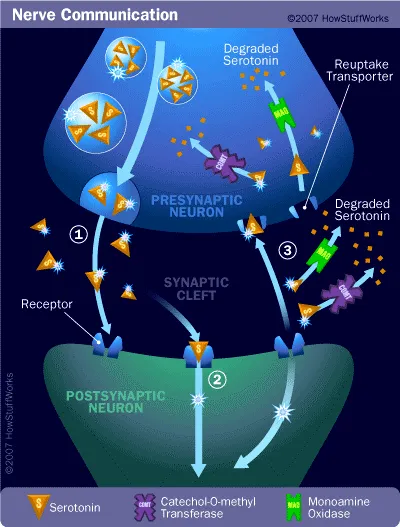
Let’s look at this process in a neuron that uses the neurotransmitter serotonin:
- The presynaptic cell (sending cell) makes serotonin (5-hydroxytryptamine, 5HT) from the amino acid tryptophan and packages it in vesicles in its end terminals.
- An action potential passes down the presynaptic cell into its end terminals.
- The action potential stimulates the vesicles containing serotonin to fuse with the cell membrane and dump serotonin into the synaptic cleft.
- Serotonin passes across the synaptic cleft, binds with special proteins called receptors on the membrane of the postsynaptic cell (receiving cell) and sets up a depolarization in the postsynaptic cell. If the depolarizations reach a threshold level, a new action potential will be propagated in that cell. Some neurotransmitters cause the postsynaptic cell to hyperpolarize (the membrane potential becomes more negative, which would inhibit the formation of action potentials in the postsynaptic cell). Serotonin fits with its receptor like a lock and key.
- The remaining serotonin molecules in the cleft and those released by the receptors after use get destroyed by enzymes in the cleft monoamine oxidase (MAO), catechol-o-methyl transferase (COMT). Some get taken up by specific transporters on the presynaptic cell (reuptake). In the presynaptic cell, MAO and COMT destroy the absorbed serotonin molecules. This enables the nerve signal to be turned “off” and readies the synapse to receive another action potential.
A similar process occurs for noradrenaline, which is also implicated in mood, emotions and major depressive disorder. Serotonin, noradrenaline and dopamine are chemically similar and belong to a class of neurotransmitters called monoamine neurotransmitters. Because these chemicals are structurally similar, they are all recognized by the enzymes MAO and COMT.
Serotonin, noradrenaline and dopamine have been the main neurotransmitters focused on by clinical studies and current medicine work to influence them. However, several other neurotransmitters exist such as Acetylcholine and gamma amino butyric acid (GABA). Any given neuron produces only one type of neurotransmitter. Any one nerve cell may have synapses on it from excitatory presynaptic neurons and from inhibitory presynaptic neurons. In this way, the nervous system can turn various cells (and subsequent neural pathways) “on” and “off.” Finally, nerve cells synapse on effector cells (muscles, glands, etc.) to evoke or inhibit responses.
- How SSRI antidepressants work
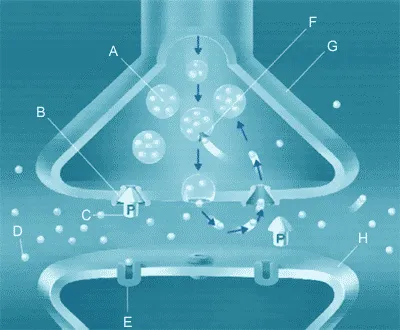
Demonstration of SSRI action: Serotonin (shown as small spheres, D) is produced in vesicles (A) within the nerve cell (presynaptic neuron, terminal end shown, G). These vesicles migrate to the cell surface (downward arrows), merge with it, and release serotonin into the synaptic cleft (space between neurons). Some of the serotonin travels across the cleft and enters receptors (E) of the postsynaptic neuron (H), which then opens channels for flow of ions, causing transmission of a nerve impulse. Some of the serotonin flows back into the nerve cell and is recycled (shown by upward arrows and F); this is reuptake of serotonin. The SSRI drug molecules (labelled P) fit the channels (B) that allow reuptake, and block them (C). Because of the drug action, more of the serotonin remains in the space outside the nerves where it can interact with receptors to influence the state of the nerve.
