
Schizophrenia Isn’t Just a Diagnosis — It’s a Pattern with Underlying Causes
Schizophrenia can feel overwhelming —
not just for the person experiencing it, but for families searching for answers.
Voices. Paranoia. Confusion. Emotional withdrawal.
At times, it can feel frightening.
Unpredictable.
The kind of isolating that’s hard to explain to anyone who hasn’t lived it.
Medication can reduce symptom intensity for many people.
But often, the deeper question remains:
Why is this happening — in this person, at this time?
Modern research shows that schizophrenia-spectrum symptoms rarely arise from a single cause.
They reflect a complex mix of genetics, brain chemistry, stress biology, trauma and environmental exposures.
Researchers are also continuing to investigate the roles that inflammation and nutritional factors may play.
For one person, chronic stress may be an important part of the picture.
For another, there may be a nutritional deficiency or another health issue worth addressing alongside their psychiatric care.
What matters will be different for each person.
The list of possible contributors is long, and for the person living it, what matters most is being taken seriously and supported — whether or not a clear contributing factor is ever found.
When we begin to look at what might be contributing, patterns can emerge.
Understanding what’s contributing, alongside good psychiatric and psychological care,
can be part of finding your way back to a life that feels genuinely yours.

A Personal Note from George
If you or someone you love has just been given this diagnosis, I want to acknowledge something before anything else:
the fear and confusion you’re feeling right now make complete sense.
This is a lot to take in, all at once.
Schizophrenia is, in my view, one of the most confronting and misunderstood mental health conditions a person can face.
It doesn’t just affect the individual diagnosed —
it can disrupt families, relationships, identity, and a person’s basic sense of safety in the world.
And this is something I wish more people understood from the outset:
👉 Schizophrenia is not only about voices or hallucinations.
For many, the deepest suffering happens beneath the surface —
a relentless internal struggle marked by fear.
By confusion.
And often, by a depression that few people around them ever truly see.
For some, it feels like a war zone inside the mind —
where inner conflict makes even simple daily functioning feel impossible.
The illness itself can bring emotional numbness or low motivation, while medication can sometimes add sedation or emotional blunting —
and reclaiming clarity, motivation or meaning can take real, deliberate work.
Staying on medication isn’t always straightforward either —
sometimes because schizophrenia itself can affect insight and trust,
and sometimes simply because of how the medication feels day to day.
One of the patterns I see often is how easily early schizophrenia can be missed.
Early signs can overlap with stress, trauma, substance use, or burnout —
which makes them genuinely difficult to distinguish from other things at first.
In my experience, it’s rarely one thing.
Genetic vulnerability can be part of the picture, alongside a complex mix of biological, psychological and environmental factors that looks different from one person to the next.
And this matters —
because schizophrenia doesn’t look the same in everyone.
Some people experience milder functional impairment.
Others face persistent hallucinations, paranoia, or long-term disability.
Wherever someone falls on that spectrum, there is hope, even if progress isn’t always a straight line.
With the right combination of support, over time:
Stability can improve.
Distress can ease.
And quality of life — genuinely, not just on paper — can change.
What Is Schizophrenia? A Functional View of the Condition
So, what schizophrenia is — and what it isn’t — is often misunderstood.
Schizophrenia is a complex psychiatric condition that affects how a person thinks, feels, and experiences reality.
It may involve hallucinations, delusions, disorganised thinking, emotional blunting, or social withdrawal.
For many people, the very first question is the most basic one:
what type of disorder is schizophrenia, exactly?
The key point is this:
👉 Schizophrenia is not just a label — and schizophrenia is not caused by one single factor.
This reflects contemporary understanding of schizophrenia as a condition shaped by genetic vulnerability, neurological and biochemical factors, psychological history, and environmental exposures, layered together rather than explained by any single cause.
A functional approach then asks whether there are additional health, nutritional or lifestyle factors worth addressing as part of your overall care.
Alongside symptom management, we can also ask:
- Why do symptoms emerge when they do?
- Why do they fluctuate?
- Why do some treatments help some people but not others?
While no single supplement can treat schizophrenia on its own — and I want to be upfront about that —
some people experience genuine benefit in areas like sleep, nutrient status, or general wellbeing when natural therapies are used thoughtfully alongside appropriate psychiatric care.
And this is where things become particularly interesting:
For some clients, addressing an identified nutritional deficiency or relevant health issue can be a useful part of adjunctive care —
particularly when that’s identified through testing and considered alongside psychiatric treatment, not instead of it.
The process is structured around your history, your symptoms, and relevant testing —
not applied the same way for everyone.
Depending on the individual, some areas that may be worth considering include:
- Nutrient levels that may be lower than ideal
- Markers associated with oxidative stress
- Ongoing low-grade inflammation
- A history of significant stress or trauma
- Long-term patterns in how the stress-response system works
The goal isn’t to oversimplify —
it’s to understand the health, lifestyle, and biological factors that may be affecting someone’s functioning and wellbeing,
and to help you build a life that isn’t defined by the diagnosis.

Signs and Symptoms of Schizophrenia

For many people, the early signs of schizophrenia are subtle and confusing — and for those living with schizophrenia, symptoms often don’t appear all at once, but emerge gradually, affecting daily functioning, relationships, and sense of self.
People searching for schizophrenia early symptoms or schizophrenia warning signs are often looking for exactly this: the quiet, easy-to-miss changes that can appear long before a diagnosis is made.
Symptoms usually become recognisable when they persist, intensify, or begin interfering with daily life.
- Hearing voices or sensory experiences others do not perceive
- Unusual beliefs or paranoia, such as feeling watched, followed, or unsafe
- Disorganised thinking or speech, where thoughts feel jumbled or difficult to express
- Flat or blunted emotions, with reduced facial expression or vocal tone
- Loss of motivation or difficulty completing everyday tasks
- Social withdrawal from friends, family, or work
- Loss of pleasure in activities that once felt meaningful
- Changes in sleep, appetite, or personal hygiene
Here’s the important part…
Symptoms don’t look the same for everyone.
- For some, they develop gradually.
- For others, they appear suddenly after a triggering event.
Symptoms may also overlap with:
- Trauma responses
- Bipolar disorder
- Substance use
- Extreme or prolonged stress
- Neurochemical imbalances
This is why a compassionate, functional assessment — one that looks beyond labels and explores biochemistry, nutrient status, neurochemistry, trauma history, and environmental stress — is often essential for understanding what’s really happening beneath the surface.
Understanding How Schizophrenia Symptoms Develop
While the symptoms above are the ones most people recognise, clinicians often describe schizophrenia using three broad symptom categories. Understanding these categories can help explain why the condition looks so different from one person to another.
Positive Symptoms
These are experiences that are added to a person’s usual perception of reality.
They may include:
- Hearing voices or sensory experiences others do not perceive
- Unusual beliefs or paranoia, such as feeling watched, followed, or unsafe
- Disorganised thinking or speech
This is often what people mean when they ask, “Does schizophrenia cause hallucinations?” The answer is yes. Hallucinations — particularly hearing voices — are among the best-known symptoms of schizophrenia, although not everyone experiences them.
Negative Symptoms
Negative symptoms involve a reduction or loss of normal functioning rather than the addition of new experiences.
They may include:
- Flat or blunted emotions
- Loss of motivation
- Social withdrawal
- Reduced enjoyment of activities
- Difficulty maintaining everyday routines and self-care
These symptoms are often less obvious than hallucinations or delusions, yet they can have an equally significant impact on quality of life.
Cognitive Symptoms
Schizophrenia can also affect the way the brain processes information.
Some people experience:
- Difficulty concentrating
- Problems with working memory
- Slower thinking or processing speed
- Difficulty organising thoughts and making decisions
These cognitive changes are often overlooked, yet they can strongly influence work, study, relationships, and everyday independence.
Recognising the Phases of Schizophrenia
Schizophrenia symptoms also tend to develop in recognisable phases rather than appearing all at once.
Prodromal Phase
This early stage may involve subtle changes in mood, sleep, concentration, motivation, or social interaction. These changes can easily be mistaken for stress, burnout, anxiety, or depression.
Active Phase
This is the stage where hallucinations, delusions, or significantly disorganised thinking become much more noticeable and often lead to assessment and diagnosis.
Residual Phase
After the most intense symptoms settle, many people continue to experience quieter but persistent difficulties such as reduced motivation, emotional flattening, or cognitive changes.
Not everyone experiences these phases in exactly the same way. Some people move gradually between them, while others experience a more rapid onset. Understanding these patterns can help individuals and families recognise when changes are occurring and seek support earlier.
Schizophrenia in Children and Teenagers
Schizophrenia in children is rare, and onset in teenagers, while still uncommon, is more frequently discussed — most people who develop schizophrenia first show symptoms in their late teens to twenties. In younger people, early signs can be especially difficult to separate from typical adolescent changes: increased irritability, social withdrawal, a drop in academic performance, or unusual beliefs can just as easily reflect ordinary teenage stress, trauma, or substance use as an emerging psychotic illness. This is exactly why a careful, unhurried assessment matters so much in younger people — jumping to conclusions in either direction, dismissing real warning signs or over-pathologising ordinary adolescent struggle, can both cause harm. Where schizophrenia is genuinely present in a younger person, the same functional principles apply: understanding the individual’s biochemistry, nutrition, stress history, and environment alongside appropriate psychiatric care, rather than relying on medication alone.
Schizophrenia and Autism: Understanding the Overlap
Some features of schizophrenia and autism can look similar from the outside — social withdrawal, unusual speech patterns, intense or unusual beliefs, and difficulty reading social cues can appear in both. This has led to genuine searches asking whether the two conditions are connected, so it’s worth being clear about what the overlap actually is, and isn’t.
Autism does not cause schizophrenia, and schizophrenia does not cause autism — they are separate conditions with different origins, different developmental patterns, and different core features. Autism is a neurodevelopmental profile present from early life, involving differences in social communication and sensory processing. Schizophrenia is a psychotic disorder that typically emerges later, usually in the late teens to twenties, and centres on hallucinations, delusions, or disorganised thinking that represent a break from someone’s usual functioning.
That said, some people genuinely experience both conditions together, and the overlapping surface features can occasionally complicate diagnosis — particularly in autistic people, whose intense interests, unusual speech patterns, or social withdrawal might be misread as emerging psychosis, or whose genuine psychotic symptoms might be dismissed as ‘just autism.’ Untangling which features belong to which condition — or whether both are genuinely present — is exactly the kind of careful differential assessment that shapes what kind of support will actually help.
“I thought it was just stress…”
“I didn’t realise voices and mistrust could mean something deeper…”
“I’d seen five therapists before anyone suggested testing…”
Some people come across terms like “schizo schizophrenia” online — language that often reflects stigma or misunderstanding rather than the lived reality of the condition.
Natural Therapies for Schizophrenia: How Functional Support Can Help

Many people ask whether natural therapies can play a meaningful role in supporting schizophrenia. The answer is more nuanced than a simple yes or no.
While no herb or supplement can treat schizophrenia on its own, many people experience meaningful improvements when natural treatments are used alongside psychiatric care.
But here’s where things get interesting…
For some clients, targeted nutrient therapy helps reduce symptoms, improve stability, or soften medication side effects — especially when neurochemical imbalances are part of the picture.
And it’s not just anecdotal.
“In peer-reviewed journals, psychiatrists are now acknowledging nutrient deficiencies in schizophrenia—particularly zinc, B6, and methylation cofactors—as factors that influence treatment success.”
Commonly Used Evidence-Supported Supports
When testing and clinical presentation suggest benefit, functional approaches may include:
- Zinc & B6 (P5P) — often helpful in undermethylation or pyroluria; supports neurotransmitter balance and oxidative stress reduction
- NAC — supports glutathione production and may reduce oxidative and inflammatory stress
- SAMe / methyl donors — used cautiously and only when indicated, based on methylation testing
- Magnesium L-threonate — supports neural calm and cognitive function
- Omega-3 fatty acids — support neuronal membrane stability and anti-inflammatory pathways
Important safety note: These therapies must be personalised. Certain supplements — particularly methyl donors — can worsen symptoms in some individuals if used incorrectly. This is why self-prescribing is not recommended, and functional testing plus professional guidance are essential.
Can You Recover Without Medication?
This is one of the most common — and most sensitive — questions.
The honest answer: complete recovery from schizophrenia without medication is uncommon, and attempting to stop medication abruptly can be unsafe.
However, there’s more nuance than most people are told.
Many clients experience better clarity, fewer relapses, and improved daily functioning when medication is combined with targeted nutritional, biochemical, and stress-regulation support.
At BalanSoul, we don’t push people to stop medication.
We work with what’s already in place.
When clinically appropriate and medically supervised, gradual dose reduction may be explored — but always prioritising safety and stability.
For many people, the most effective approach is:
- Low-dose medication
plus - Targeted nutrient and functional therapy
Why this combination works:
- The brain stabilises more predictably
- Side effects are often reduced
- Long-term resilience improves
- Some clients maintain stability on lower doses over time
Every case is unique.
Every plan prioritises safety.

“What If It’s Not Schizophrenia?”
Here’s something rarely discussed:
Not all psychotic-like symptoms are schizophrenia.
Trauma responses, bipolar disorder, sleep deprivation, severe anxiety, B12 deficiency, heavy-metal exposure, histamine intolerance, and medication reactions can all mimic or overlap with psychotic symptoms.
Substance use deserves particular mention here, too: cannabis, amphetamines, and hallucinogens can each trigger psychotic symptoms that closely resemble schizophrenia, sometimes resolving once the substance clears and sometimes revealing an underlying vulnerability that persists afterward.
That’s why, at BalanSoul, we consider all plausible causes — biochemical, neurological, nutritional, and environmental — before drawing conclusions.
Understanding why symptoms are happening is often the first step toward meaningful recovery.
Root Causes & Functional Medicine Approach to Schizophrenia
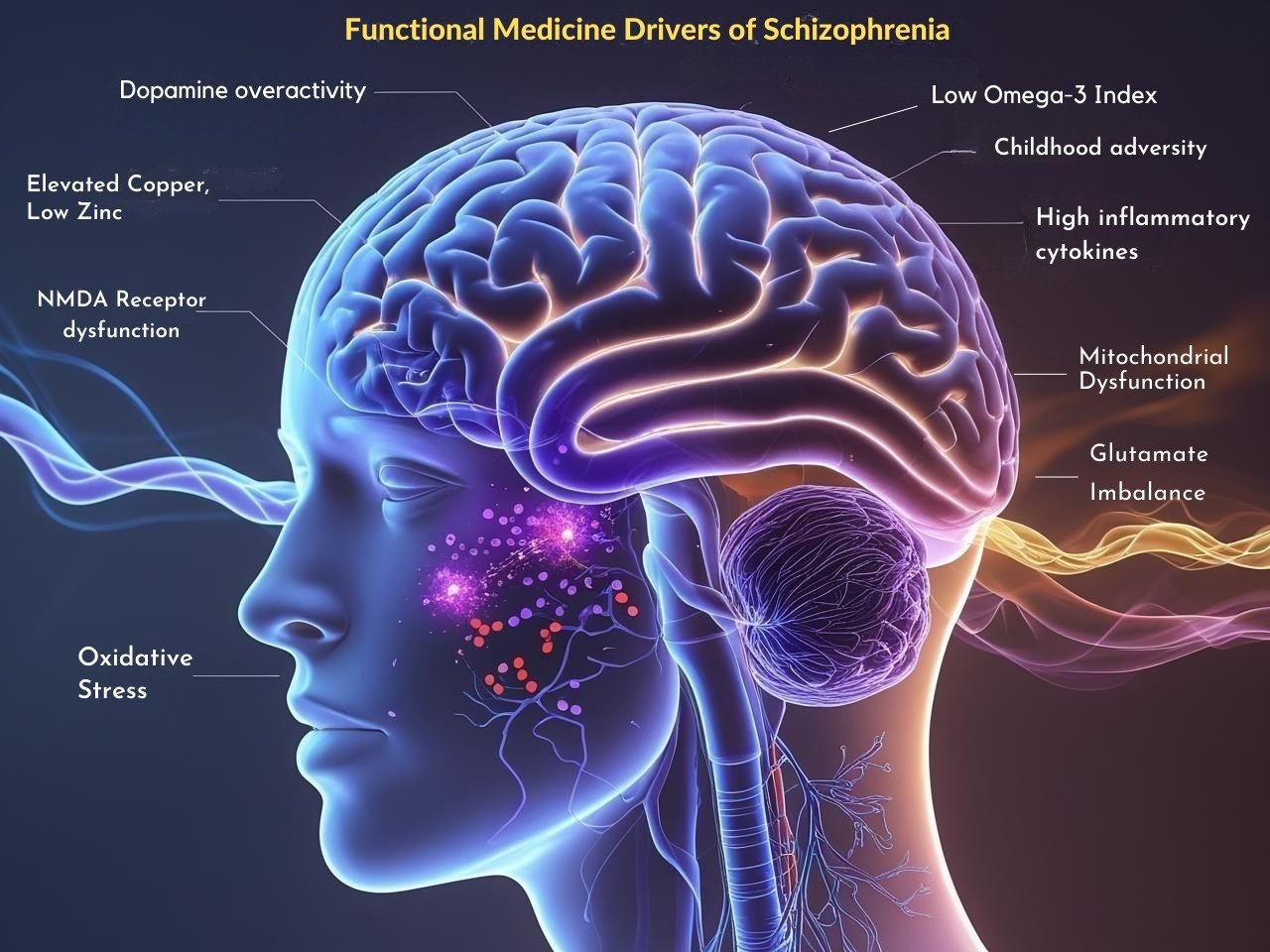
Functional medicine asks a different question.
Rather than focusing only on diagnosis, we ask a deeper and more personal question: what causes schizophrenia in this individual, at this point in time?
Not just:
“What is the diagnosis?”
But:
“Why is this happening in this person?”
In many ways, this whole section is a page-long answer to the question of why schizophrenia happens for any one individual — because that answer is never the same twice.
Schizophrenia symptoms rarely appear in isolation.
In most cases, they emerge after the system has been pushed beyond its capacity — by a combination of biological vulnerability and life stressors.
At BalanSoul, we look beneath the label to understand the full web of contributing factors, which may include:
- Neurochemical and receptor imbalances
- Nutrient deficiencies affecting brain signalling
- Oxidative stress and mitochondrial strain
- Inflammation and immune activation
- Trauma or chronic stress exposure
- Genetic and epigenetic influences
Here’s the key insight:
Whether the dominant driver is copper overload, childhood trauma, oxidative stress, glutamate imbalance, or an undiagnosed pyrrole disorder — there is always a reason symptoms take the form they do.
And when those drivers are identified and addressed, the nervous system can stabilise.
This is why functional medicine moves beyond symptom suppression alone.
It allows us to design support that restores balance at the biochemical level — while also respecting the emotional and environmental context of the person’s life.
That deeper understanding is what makes targeted testing, biotype identification, and personalised treatment possible.
Key Root Contributors to Consider:
1. Neurochemical & Receptor Imbalances
- Dopamine overactivity — often linked to hallucinations, paranoia, psychosis, and intrusive thought
- NMDA receptor dysfunction — contributes to cognitive decline, thought disorganization, and dissociation
- Glutamate imbalance — elevated levels may trigger excitotoxicity, agitation, and panic-like states
These neurochemical patterns rarely exist on their own, though — they’re often shaped by what’s available (or missing) from diet and genetics.
2. Nutrient & Genetic Factors
- Elevated copper / low zinc — disrupts neurotransmitter balance, increases oxidative stress
- B6, B12, and folate deficiencies — impair methylation, myelination, and neurotransmitter synthesis
- Methylation imbalances (under- or overmethylation) — alter serotonin, dopamine, and histamine pathways
- Folate intolerance / methylfolate sensitivity — may worsen symptoms in sensitive biotypes
- Pyrrole disorder (Pyroluria) — leads to chronic B6 + zinc loss, emotional dysregulation, irritability, and dreamlessness
- Impaired SAMe / SAH ratio — signals blocked methylation cycles often seen in complex psychiatric cases
When these nutrient and genetic patterns go unaddressed for long enough, the strain shows up elsewhere too — often as inflammation and cellular stress.
3. Inflammation, Oxidative Stress & Cellular Energy Deficits
But what happens when the brain becomes overwhelmed by inflammation and oxidative pressure?
These pathways begin to break down.
- High inflammatory cytokines — linked to cognitive fog, mood instability, and fatigue
- Elevated quinolinic acid — neurotoxic metabolite associated with suicidality and NMDA overactivation
- Mitochondrial dysfunction — reduces neuronal energy output and stress tolerance
- Low Omega-3 Index (EPA/DHA) — affects membrane fluidity, neurotransmitter signalling, and neuroprotection
And there’s one driver of inflammation that rarely gets the attention it deserves: the gut.
4. Gut–Brain Axis Disruption
And here’s something many people overlook:
The gut profoundly influences neurotransmitter function.
- Dysbiosis & intestinal permeability — can trigger systemic inflammation and serotonin disruption
- Antibiotic use in childhood or repeated courses — may alter microbiome diversity and future stress resilience
None of these internal patterns exist in a vacuum, either — the environments someone lives in and has lived through shape all of the above.
5. Environmental & Trauma-Linked Contributors
Consider this:
The brain is shaped by the environments it is exposed to — especially early in life.
- Childhood adversity, neglect, or attachment rupture — sensitizes the limbic system and stress circuits
- Mould, chronic infections, or toxic exposures — can provoke neuroinflammation in susceptible individuals
- Heavy metal exposure (lead, mercury, arsenic) — associated with cognitive decline and psychosis-like symptoms
These are among the most common schizophrenia environmental factors and schizophrenia triggers we assess for — not as isolated causes, but as part of the fuller picture.
And when these pressures accumulate over enough time, they can eventually leave a physical, measurable mark on the brain itself.
6. Structural & Metabolic Disruption
- White matter loss & myelin sheath damage — seen in long-term schizophrenia; linked to B12 deficiency and oxidative stress
- Elevated homocysteine — signals methylation impairment and correlates with cognitive dysfunction
⭐ The Bigger Picture
Schizophrenia is not a “single-pathway” condition — it is a mosaic of biochemical, genetic, neurological, environmental, and emotional factors.
And this leads to a crucial insight:
No one treatment can fully resolve it.
The most meaningful improvements occur when we address healing from every angle:
- restoring nutrient balance
- calming neuroinflammation
- supporting neurotransmitter pathways
- repairing gut integrity
- strengthening stress regulation
- integrating mind–body therapies
- and addressing social and emotional layers of the person’s story
This is where functional psychiatry shines. At BalanSoul, we specialise in connecting the dots — uncovering what standard approaches may overlook, not just managing symptoms but understanding why they appeared. When we treat the person, not just the diagnosis, real recovery becomes possible.
The Walsh Protocol & Functional Testing for Schizophrenia
“Schizophrenia isn’t one disease — and it can’t be solved with one drug.”
– Dr. William J. Walsh, PhD
At BalanSoul, we look beyond diagnostic labels to uncover the biochemical drivers of schizophrenia.
But why does this matter?
Because many individuals with schizophrenia-spectrum symptoms show distinct, measurable patterns in their brain chemistry — patterns that standard psychiatric assessments rarely detect.
The Walsh Protocol — based on over 30,000 cases — shows that many individuals with schizophrenia-spectrum symptoms present with distinct, measurable patterns in brain chemistry.
According to Dr. Walsh’s clinical database, more than 60% of individuals with schizophrenia exhibit significant methylation imbalances or related nutrient-pattern abnormalities often missed in standard care.
And here’s the key insight: These patterns aren’t theoretical. They influence how someone responds to medications, folate, SAMe, B6, or even environmental stress — and often explain why conventional treatment alone doesn’t always stabilize symptoms.
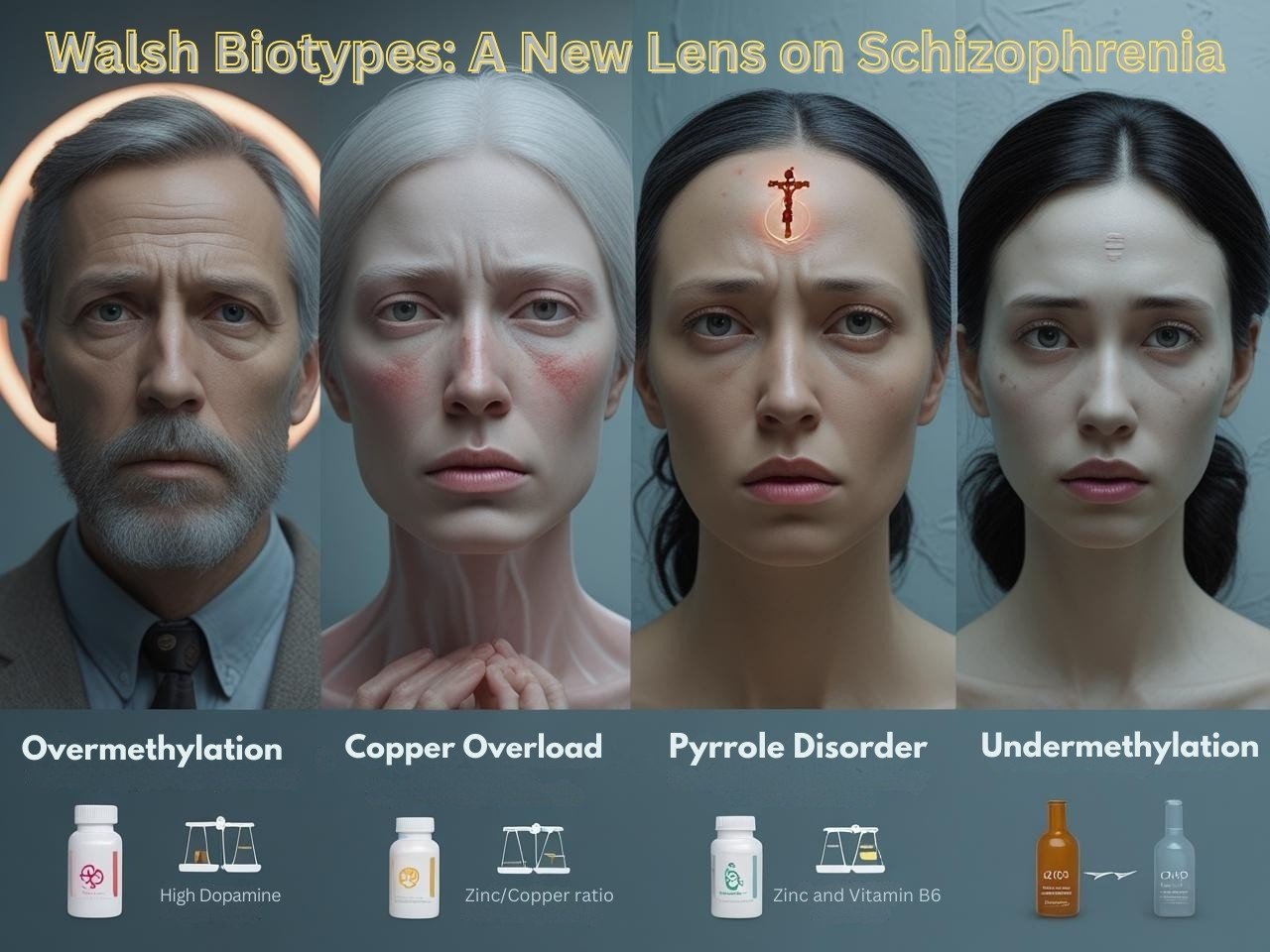
Let’s explore the most common biotypes seen in schizophrenia.
Common Biotype Patterns in Schizophrenia (Walsh Model)
Overmethylation + Excess Dopamine
- Seen in paranoid schizophrenia and delusional states
- Traits: high dopamine, low histamine, religiosity, sensory amplification, panic, grandiosity
- 🧠 Support: Folate, B12, niacinamide, DMAE, zinc
- ⚠️ Caution: May worsen with SAMe or methyl donors
Copper Overload
- Elevates norepinephrine → fuels paranoia, inner agitation
- Common in females, especially postpartum or on birth control
- 🧠 Support: Zinc, B6, selenium, MT-promoting nutrients
- ⚠️ Must decopper slowly to avoid irritability spikes
Pyrrole Disorder
- Depletes zinc and B6 → leads to dreamlessness, inner tension, emotional fragility
- 🧠 Support: High-dose P5P, zinc, biotin, GLA
- 📈 Often rapid improvement with targeted protocol
Undermethylation (in some subtypes)
- High histamine, low serotonin → may present with OCD traits or emotional flatness
- 🧠 Support: SAMe, methionine, zinc, magnesium
- ⚠️ Avoid folate unless carefully supervised
Recommended Testing

We test — not guess.
But what does this mean for you?
It means your treatment plan is guided by data, not assumptions.
Using advanced functional lab analysis, we identify your biotype and build targeted nutrient plans based on your unique biochemical fingerprint.
Typical Walsh-related tests include:
- Zinc : Copper Ratio (plasma) — copper retention pattern
- Ceruloplasmin — detects hidden copper loading
- Whole Blood Histamine — methylation status
- Pyrrole Test (HPL urine) — oxidative stress & B6/Zn demand
- SAMe : SAH ratio, B6, MTHFR / COMT SNPs — methylation capacity
- OAT Test — neurotransmitters, inflammation, oxidative stress
Why This Testing Matters
Medication can reduce symptoms — but without biochemical support, progress often plateaus.
Many clients are told they’re “treatment-resistant,” when in reality their brain chemistry hasn’t been properly matched.
Once a biotype is identified, we can:
- Support medication response rather than working against it
- Reduce side-effect burden
- Improve stability, resilience, and long-term outcomes
Functional testing gives us clarity — not just about what is happening, but why.
And when we understand the “why,” meaningful progress becomes possible.
Lifestyle and Mind–Body Support
Biochemistry and testing are only part of the picture. Alongside psychiatric care and targeted nutrient support, everyday rhythms and relationships can meaningfully influence stability, resilience, and quality of life. None of this is about willpower or discipline — it’s about gently reducing the overall load on a nervous system that’s already working hard.
- Sleep and daily routine — consistent sleep and a predictable daily structure can help regulate the same stress and neurotransmitter systems discussed earlier in this page. Where possible, regular wake times can ease some of the unpredictability schizophrenia often brings.
- Nutrition — a steady, nutrient-dense diet supports the biochemical foundations already described, while dramatic or restrictive diet changes are rarely helpful and can add unnecessary stress.
- Movement — regular, gentle movement (walking, stretching, or any enjoyable physical activity) can ease stress hormones and support mood, without needing to become intense or competitive.
- Stress reduction and nervous-system regulation — simple practices such as breathwork, grounding techniques, or mindfulness-based approaches can help calm an overactive stress response, though these work best as one part of a broader plan, not a replacement for medical care.
- Social connection and meaningful activity — isolation can quietly deepen negative symptoms, while gentle, low-pressure social contact and activities that feel genuinely meaningful, even small ones, can support motivation and a sense of purpose.
- Reducing alcohol and recreational drug use — where relevant, reducing alcohol or recreational substance use (particularly cannabis and stimulants) can meaningfully ease symptom intensity and unpredictability, given how directly these substances can interact with the same neurochemical pathways discussed earlier.
- Family support — schizophrenia affects the whole family system, not just the individual. Involving trusted family members or carers, where the person wants this, can ease pressure and improve consistency of support at home.
- Realistic self-care — none of this needs to happen perfectly or all at once. Small, sustainable changes, chosen collaboratively rather than imposed, tend to matter far more than an ambitious plan that’s abandoned within a week.
Why Choose BalanSoul — And What to Expect When Working With Us

Schizophrenia doesn’t just affect perception — it can disrupt identity, trust, motivation, relationships, and a person’s sense of safety in the world.
That’s why our care is personal, measured, and deeply human.
At BalanSoul, we don’t rush decisions or apply one-size-fits-all protocols. We walk with you patiently, strategically, and compassionately — whether you’re newly diagnosed, medication-sensitive, supporting a loved one, or searching for a deeper, integrative approach.
Your Initial Consultation (90 Minutes)
Your first session is a comprehensive 90-minute consultation — not a quick check-in or surface-level discussion.
This time allows us to truly understand the whole picture, including:
- Mental health history and symptom timeline
- Medication use, responses, and sensitivities
- Periods of stability, relapse, or functional decline
- Nutritional status, stress load, sleep, and nervous-system patterns
- Relevant lab results or previous testing
- Your goals, concerns, and pace preferences
This depth gives us clarity — so we move forward safely, thoughtfully, and proactively, rather than reactively.
What You’ll Receive
Based on your history, biochemistry, and current stage, you’ll receive:
A personalised care plan, grounded in functional and biochemical assessment
Targeted nutrition and supplement guidance, aligned with Walsh Protocol and functional psychiatry principles
Clear education, so you understand what’s happening — and why
Nervous-system and lifestyle support tailored to stability, rhythm, and resilience
A step-by-step roadmap, not a generic protocol
Our focus is always on addressing root causes, not just suppressing symptoms.
Ongoing Support (Not One-Off Care)
Schizophrenia — and recovery — is rarely linear. Neither is our care.
As you move through each phase, we continue to:
Adjust nutrients and strategies as your system responds
Support nervous-system regulation and emotional stability
Help distinguish temporary setbacks from true relapse
Refine your plan using real-time feedback, not assumptions
This is collaborative care, at your pace — focused on restoring trust in your body, not forcing change.
There is a path forward — one step at a time.
With informed, compassionate support, stability can improve, distress can soften, and clarity can return.
You don’t have to rush.
You don’t have to push.
And you don’t have to do this alone.
Click below to explore our testing options or book a free discovery call.
FAQ
Can I still take medication?
Yes. We support both medicated and unmedicated clients. We work with your existing care team to ensure safety and integration.
What if I’ve been misdiagnosed?
We assess your symptoms through a functional medicine lens. Not every case of paranoia or hallucinations is schizophrenia — and sometimes testing reveals underlying drivers like B12 deficiency, trauma-related dissociation, or substance-induced psychosis.
Is this safe for my adult child or elderly parent?
Yes — all plans are tailored to the life stage and functional ability of the client.
Does schizophrenia run in families? Is it genetic?
Genetics can meaningfully increase vulnerability — having a close family member with schizophrenia does raise individual risk above the general population average. But genetics alone rarely tells the whole story: most people with a family history never develop schizophrenia, and most people who do develop it have no known family history at all. So if you’re asking is schizophrenia genetic, the honest answer is: partly, but not deterministically. It’s better understood as one contributing vulnerability among several, not a fixed inheritance — which is exactly why we look at genetic tendencies alongside nutrient status, inflammation, trauma history, and environmental exposures, rather than treating family history as a verdict.
Is schizophrenia the same as schizoaffective disorder, or a personality disorder?
The confusion between schizophrenia and schizoaffective disorder is understandable — the two share real overlap. Schizoaffective disorder shares schizophrenia’s psychotic features but also involves a significant, sustained mood component — depressive or manic episodes — that isn’t part of a typical schizophrenia diagnosis. And to directly answer is schizophrenia a personality disorder — no, not at all: personality disorders involve longstanding, pervasive patterns of thinking and relating to others, while schizophrenia is a psychotic disorder involving hallucinations, delusions, or disorganised thinking that represent a genuine break from a person’s usual functioning. Getting this distinction right matters, because the most effective support looks quite different for each.
Is schizophrenia the same as bipolar disorder?
No — though the two can genuinely overlap, and searches for schizophrenia bipolar often reflect this exact confusion, including terms like ‘type I schizophrenia’, which isn’t an actual clinical classification — that confusion likely comes from Bipolar I Disorder, an entirely separate diagnosis with its own numbering. Bipolar disorder is primarily a mood disorder built around manic and depressive episodes, which can sometimes include psychotic features during their most severe phases. Schizophrenia is primarily a psychotic disorder, where hallucinations, delusions, or disorganised thinking are the defining feature rather than an occasional complication of mood. Some people are diagnosed with schizoaffective disorder specifically because their presentation includes strong features of both — which is one of many reasons an accurate, personalised assessment matters more than the label itself.
What are the different types of schizophrenia?
Older classifications you may still come across online — paranoid, catatonic, disorganised, and undifferentiated schizophrenia (sometimes searched as schizophrenia undifferentiated type) — were formally consolidated into a single diagnosis under the DSM-5 in 2013, in recognition that these categories overlapped heavily and that the same person’s presentation often shifted between them over time. So if you’re searching for schizophrenia types, the most accurate current answer is that clinicians today generally describe schizophrenia along a spectrum of symptom domains and severity, rather than sorting people into fixed subtypes. You may still encounter the older terms in casual conversation or older material, and they can still be useful as descriptive language — but they no longer represent separate formal diagnoses.
Is schizophrenia curable?
Most current understanding treats schizophrenia as a manageable, long-term condition rather than one with a defined cure. That’s not the same as saying nothing changes: with the right combination of medical care, biochemical support, and lifestyle regulation, many people experience substantial, lasting improvements in symptoms, stability, and quality of life. We think the more honest and more useful question isn’t ‘can this be cured,’ but ‘how much better can this get for you, specifically’ — and for many people, the answer is meaningfully better than they expect when they’re first diagnosed.
Can drug or alcohol use cause schizophrenia-like symptoms?
People often ask, “can schizophrenia be caused by drugs?” Yes — substance-induced psychosis is a real and distinct clinical picture, and it’s one of the most important things to rule out before assuming a schizophrenia diagnosis is permanent. Cannabis (particularly high-THC forms), amphetamines, and hallucinogens are the most commonly implicated substances, and in some people they can trigger psychotic symptoms that closely resemble schizophrenia. Sometimes these episodes resolve once the substance is cleared and support is in place; in others, substance use appears to have triggered an underlying vulnerability that persists afterward. Either way, an honest conversation about substance use is a standard, non-judgemental part of a thorough assessment — not an accusation.