
Addiction Recovery with Integrative Psychiatry
❝What if addiction isn’t the real problem… but your brain’s attempt to cope with a deeper one?❞

Addiction rarely starts where people think it does.
Long before the substance, or the behaviour, or the thing everyone else eventually notices, there was often a nervous system that had been running in high alert for far too long, with nowhere safe for that pressure to go.
Add biochemical imbalances that turn an ordinary craving into something close to unbearable, or emotional wounds that were never given room to heal —
and the body starts looking for anything, anything, that offers a moment of relief.
Most people get this part backwards:
When the brain is overwhelmed for long periods, it doesn’t fail.
It adapts.
And it adapts for survival, not for wellbeing.
That adaptation doesn’t always look dramatic.
Sometimes it’s a drink at the end of every hard day.
Sometimes it’s a phone reached for the instant a room goes quiet.
Sometimes it’s a habit nobody — not even the person living it — would have called an addiction yet.
Whatever shape it takes, the pattern can deepen in surprisingly similar ways.
Not because someone is weak.
But because their brain has quietly learned that this particular thing works, when almost nothing else does.
This isn’t a character flaw.
It’s a chronic, brain-based condition —
shaped by dopamine dysregulation, inflammation, trauma, nutritional deficiencies, stress physiology, and unmet emotional needs, often layered on top of one another for years before anyone reaches for help.
For other people, it started differently — genetics, environment, or a brain that was simply more sensitive to begin with, long before any particular wound came along.
There’s more than one road into addiction.
This is just one of them.
By the time these factors combine, the brain has usually made certain substances or behaviours feel necessary just to get through an ordinary day —
long before the people around that person have any real sense of how much has quietly been carried underneath.
And if you’re the one who loves them, walking on eggshells, wondering what you did wrong:
you didn’t cause this.
But that doesn’t mean everything that’s happened doesn’t matter, or that you don’t get to have boundaries too.
At BalanSoul, we hold both of those things at once.
Real compassion for what got someone here.
And real science about what it will actually take for their nervous system to feel safe enough to let go.
What we actually do is combine functional testing and biochemistry, nutrient and herbal therapy, and practical lifestyle and dietary changes, built around your biology, not a generic program.
We also place real emphasis on something that can easily be overlooked:
mind-body medicine.
Nervous-system regulation techniques, meditation, guided imagery, and deep relaxation work —
because healing the biology and calming the nervous system need to happen together, not separately.
And our goal is simple, but profound:
Help your nervous system feel safe again —
because when it does, reaching for the things that hurt you stops being the only option that makes sense.
What Is Addiction, Really?
Addiction isn’t weakness.
It’s a nervous system that found a way to survive something overwhelming — and hasn’t yet learned it’s safe to put that survival tool down.
So what does that really mean?
Addiction is a complex neurobiological response — what we think of at BalanSoul as a biochemical survival pattern, not a character flaw.
Whether the pattern involves alcohol, prescription medications, weed addiction, gambling, food, phone addiction, or the need for help with porn addiction, the mechanism underneath often overlaps more than people expect.
Somewhere along the way, your brain found something that soothed the pain, or the stress, or the emptiness, or the chaos it couldn’t otherwise settle.
And at first, it genuinely worked.
That’s the part that gets left out of most conversations about addiction.
It wasn’t broken thinking that started this.
It was a solution — a real one, at the time.
But solutions that get used again and again start to change the system that relies on them.
Dopamine stops signalling the way it used to.
Cravings stop feeling optional.
Stress hormones stay switched on long after the stress has passed.
And slowly, the nervous system reorganises itself around the relief — even as everything else in life gets harder to hold together.
This is also why addiction so often begins as something protective.
Whatever form it takes — alcohol, drugs, gambling, or the steady pull toward sugar or screens — the pattern usually starts as a coping tool.
Only over time does that same adaptability turn against you — the nervous system reorganising itself around the addiction the way it once reorganised itself around survival.
It comes down to this:
It’s not simply about willpower.
It’s about a mismatch between what your nervous system needs and what it has access to.
That’s also why the urge to use can feel so overwhelming, even in someone who genuinely, desperately wants to stop.
The nervous system isn’t asking for permission.
It’s sounding an alarm, the kind reserved for real emergencies, because as far as the body is concerned, this feels like one.
When you view addiction through that lens, patterns that once felt confusing or shameful begin to make sense.
So we don’t stop at the behaviour on the surface.
We look underneath it — investigating possible contributors such as trauma and chronic stress, sleep disruption, blood-sugar instability, nutritional factors, inflammation, and the brain’s reward and calming pathways.
Healing tends to go further when it starts where the pattern actually began, not just where it happens to be visible.
This is also why two people can carry the exact same diagnosis — say, alcohol use disorder, or the same behavioural pattern — and still need completely different paths to recovery.
The substance or behaviour on the surface may be identical.
The biology and history underneath rarely are.
Which brings us to the part worth holding onto:
When the nervous system finally gets what it’s been missing — safety, steadiness, real support — the compulsive pull tends to soften.
Recovery stops feeling like a constant battle.
That’s not a promise that everything becomes easy.
Recovery can become more achievable when we’re no longer asking willpower to do all the work.
You deserve clarity.
You deserve calm.
You deserve freedom.
And you don’t have to find that path by yourself.

What Is Addiction, Really?
Addiction isn’t a moral failing—it’s a complex, chronic condition with deep roots in the brain and body.
Whether it’s alcohol, drugs, gambling, sugar, or technology, addictions often begin as coping tools. But over time, the brain’s natural balance becomes hijacked, rewired to crave the very things that harm it.
At BalanSoul, we treat addiction as a biochemical survival pattern, not a character flaw. We help you uncover the underlying imbalances—so you can reclaim clarity, stability, and freedom.
Root Causes of Addiction: What Drives It?
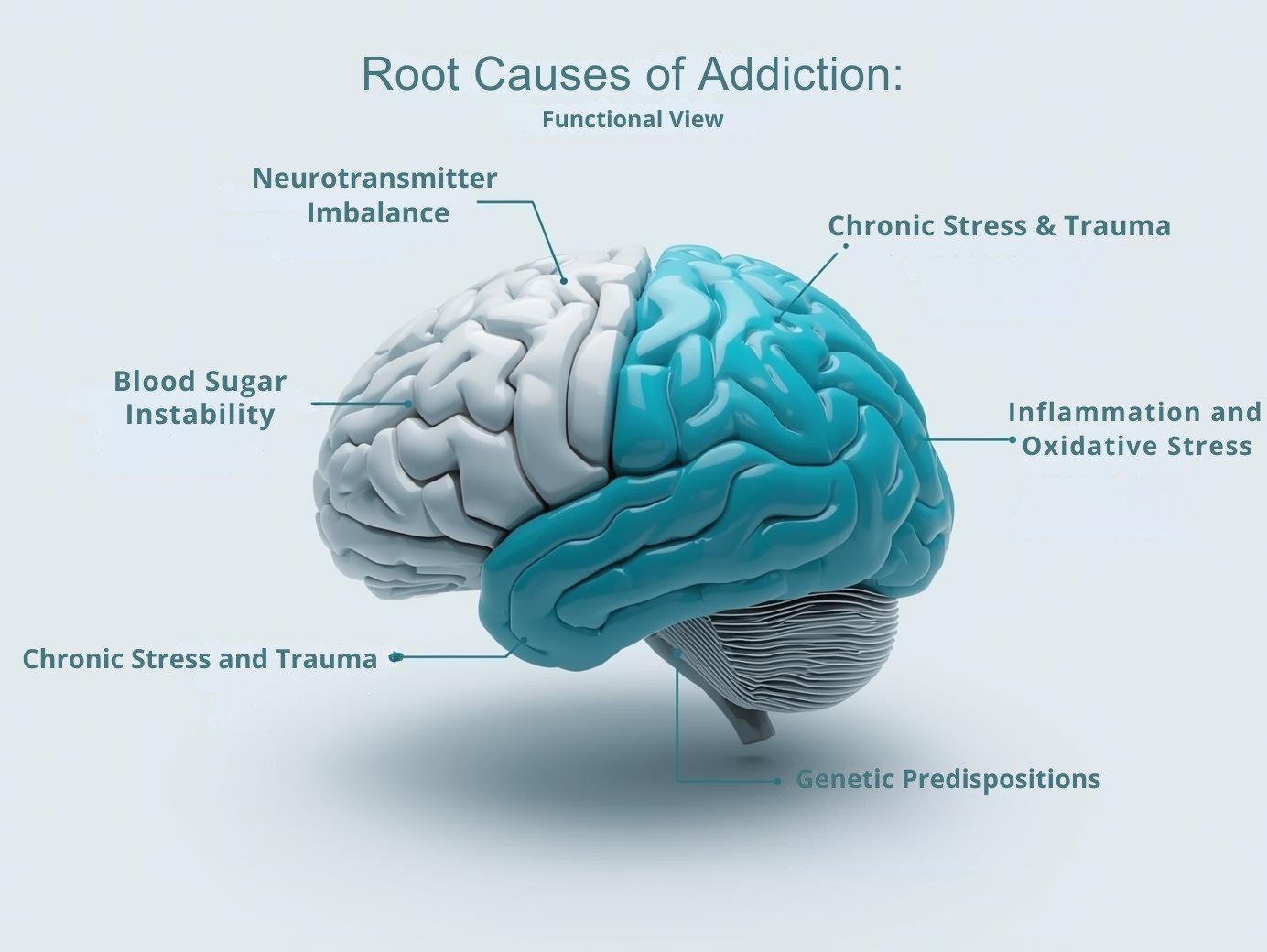
Addiction doesn’t come from weakness.
It comes from stressors that overwhelm the brain’s ability to cope.
At BalanSoul, we don’t stop at labels like cravings, compulsions, or dependency. We look beneath the surface to understand why the brain became vulnerable in the first place.
For many people, the roots lie in early trauma, chronic stress, or a nervous system that never learned how to switch off survival mode.
Here’s where things often start to connect — and where a clearer picture usually begins to form.
In many cases, the gut and nervous system are inflamed, blood sugar regulation is unstable, sleep is disrupted, and the brain is simply trying to restore balance using the tools it has available.
By identifying these deeper contributors — neuroinflammation, digestive dysfunction, stress hormone dysregulation, trauma patterns, and neurotransmitter imbalances — we uncover what your brain and body have been trying to communicate all along:
- Neurotransmitter imbalance — low dopamine, serotonin, or GABA can drive cravings, compulsions, and emotional overwhelm
- Inflammation & oxidative stress — often triggered by dysbiosis, toxins, infections, or trauma, affecting mood regulation and impulse control
- Blood sugar instability — rapid drops can mimic anxiety and trigger urges for quick dopamine “hits”. When blood sugar falls sharply, the body treats it as a metabolic emergency and releases cortisol and adrenaline to bring it back up — the same stress hormones responsible for activation and urgency elsewhere in the body. That surge can feel remarkably similar to a craving, which is one reason stabilising blood sugar is often one of the fastest ways to take the edge off a compulsive urge.
- Early-life trauma & chronic stress — rewires the stress response system, making addictive patterns more likely
- Genetic predispositions — variations in COMT, MTHFR, DRD2 and others can influence dopamine clearance, stress tolerance, and reward processing
None of this means addiction is only biochemistry — trauma, relationships, and life circumstances matter enormously. But it does mean the compulsion itself is rarely simply a matter of character. It’s what happens when biology and history combine to overwhelm the brain’s normal coping capacity.
🧪 Our functional assessments are designed to uncover these hidden drivers — so your treatment plan is tailored to what your brain truly needs to heal.
Signs & Symptoms of Addiction

Addiction is rarely obvious at first. It often shows up as overwhelm, exhaustion, or “just trying to get through the day.”
But here’s where things begin to shift:
Over time, these coping strategies reshape the brain’s reward and stress circuits — but with the right support, they are repairable.
Addiction affects every part of life — emotional, physical, relational, and biochemical.
What begins as a way to cope, numb, or feel “normal again” can slowly shift into patterns that feel harder and harder to break.
You might notice:
- Mood swings, depression, anxiety, or agitation
- Cravings, tolerance, or withdrawal
- Impulsive or risky behaviours
- Brain fog, poor concentration, or low motivation
- Sleep disruption (insomnia or oversleeping)
- Shame, isolation, or feeling “out of control”
Many of these signs get quietly filed away as stress, tiredness, or simply “how I cope” — by the person experiencing them and by the people who love them. That’s rarely denial. Early patterns don’t usually look dramatic; they look like ordinary days, with small, recurring moments nobody quite names as a problem yet.
We support recovery from many types of addiction, including:
- Alcohol
- Cannabis (weed addiction)
- Prescription medications (e.g., opioids, benzos)
- Stimulants (cocaine, meth, Ritalin misuse)
- Behavioural addictions, such as:
- Porn addiction
- Phone or screen addiction
- Food or pasta addiction (especially sugar/flour cravings)
- Gaming and gambling compulsions
🌿 Whether you are seeking alternatives to traditional addiction treatment centres, or looking for a more personalised, integrative approach, our functional psychiatry framework offers a compassionate pathway to long-term recovery — grounded in understanding, not judgement.
Functional Testing & Nutrient Assessment
Biochemical insights can be game-changers in addiction recovery.
Many people struggling with cravings, compulsive behaviours, or withdrawal symptoms are not “failing treatment” — they are dealing with underlying nutrient deficiencies, methylation issues, neurotransmitter imbalance, or chronic inflammation. These are patterns that standard addiction care often overlooks.
Here’s why this matters:
When we understand the biochemistry behind your symptoms, treatment becomes far more precise — and far more effective.
Based on your history and presentation, we may recommend targeted functional testing such as:
- Plasma zinc, copper, and ceruloplasmin
(to assess stress chemistry, mood regulation, and neurotransmitter balance) - Whole blood histamine
(to evaluate methylation status and biotype patterns) - Vitamin D, magnesium, and B-vitamin panels
- Organic Acid Testing (OAT)
(to assess neurotransmitter metabolites, mitochondrial stress, and detox capacity) - DNA profiling (e.g. MTHFR, COMT, MAO-A)
to understand dopamine regulation, stress reactivity, and nutrient processing
This is also one of the reasons two people who look almost identical on paper — same substance, similar history, even the same turning point that brought them to seek help — can end up needing very different treatment plans. The craving looks the same from the outside; the biochemistry underneath rarely is. This is often one of the most consistently overlooked pieces of the puzzle in addiction care — many people have been tested for almost everything except the biochemistry that may actually be driving the craving.
🧪 These tests help us map out the hidden drivers of addictive patterns — allowing us to tailor nutrient therapy, amino acid support, detoxification strategies, and neurological repair based on your exact biochemistry.
Nutritional & Integrative Support
Supporting recovery means rebuilding what’s depleted — and calming what’s overactive.
Many people with addiction aren’t battling a lack of willpower.
They’re battling low neurotransmitters, nutrient depletion, inflammation, and stress chemistry locked in a feedback loop.
Here’s the shift most clients notice:
When the brain receives what it’s genuinely missing, cravings soften, mood stabilises, and the nervous system finally gets space to heal.
Depending on your needs, natural supports may include:
- Zinc & B6 — foundational for neurotransmitter synthesis and methylation balance
- Magnesium — calms the nervous system, supports sleep, and eases muscle tension
- NAC (N-acetyl cysteine) — helps regulate glutamate, reduce cravings, and support detox pathways
- L-theanine or GABA — promote relaxation and reduce overstimulation. GABA is the brain’s primary inhibitory neurotransmitter — it’s what allows an overstimulated nervous system to downshift out of high alert. When GABA tone is low, that downshift becomes much harder, and the nervous system tends to stay primed to seek relief wherever it can find it. Supporting this pathway is part of why cravings often feel genuinely quieter, not just ‘managed’.
- Adaptogens such as Rhodiola or Ashwagandha — support adrenal function, resilience, and emotional steadiness
This is often the turning point that surprises people most — not a dramatic before-and-after, but a quiet sense that the urgency behind the craving has genuinely eased, long before the craving disappears completely.

Do not self-prescribe — the wrong nutrient can worsen symptoms in certain biochemical patterns.
Nutritional & Integrative Support
Supporting the brain’s recovery involves rebuilding what’s depleted—and calming what’s overactive.
Some natural supports may include:
- Zinc & B6 — foundational in methylation and neurotransmitter synthesis
- Magnesium — for calming the nervous system and improving sleep
- NAC (N-acetyl cysteine) — helps regulate glutamate and reduce cravings
- L-theanine or GABA — promote relaxation and reduce anxiety
- Adaptogens like Rhodiola or Ashwagandha — support adrenal balance
Can Recovery Happen Without Medication?
Some clients wish to explore drug-free options.
Others want to reduce reliance on medication, or combine integrative supports with their current treatment for greater stability.
What’s important to know:
We never push abrupt withdrawal.
Instead, we collaborate with your prescriber to design a safe, gradual, and staged taper where appropriate — ensuring your nervous system remains supported every step of the way.
For many people, the most effective approach blends medication support with functional psychiatry and biochemical repair.
In practice, I’ve worked with clients who assumed that reducing or coming off medication meant returning to exactly how things felt before medication ever helped — and were relieved to find that once the underlying biochemistry was properly supported, that fear largely didn’t play out the way they expected. I’ve also worked with people for whom medication remained an essential, ongoing part of their care — and for them, the goal was never to remove it, but to give the rest of their biology enough support that the medication could do its job more effectively.
With the right testing and nutrient therapy:
- Symptoms often become easier to manage
- Emotional stability improves
- Medication needs may lessen over time
And here’s the truth:
There is no one-size-fits-all.
Recovery is personal — and our role is to help you find the safest, most sustainable version of it for your brain and body.

Our 3-Step Recovery Framework

These three stages aren’t rigid boxes to move through once — in practice they overlap and loop back on each other as your body responds. But broadly, recovery tends to move through this shape:
Rebalance & Prepare for Change
Before asking your body to let go of a substance or behavior, we build you up. This includes restoring depleted nutrients, calming the nervous system, improving sleep and digestion, and preparing you emotionally to make lasting changes. Clients often say this is the first time they felt supported before trying to quit.
Restore Mood & Resilience
Once your system is more stable, we shift toward easing cravings, supporting motivation, and creating a daily rhythm that restores balance. We help you gently regulate your brain chemistry using amino acids, adaptogens, targeted supplements, and simple routines.
Maintain Recovery & Prevent Relapse
Long-term healing means working on the deeper patterns. Here, we support you with tools for stress resilience, emotional regulation, trauma recovery, and maintenance of brain health through nutrition and follow-up care.
A setback here doesn’t erase the progress that came before it — it’s usually a signal that a particular support needs adjusting, not that the whole approach has failed.
Can Natural Medicine Help Like Methadone?
We don’t replace medical detox or prescribe pharmaceuticals — but we can support the brain in similar, stabilising ways when used appropriately and alongside proper care.
Some clients benefit from targeted nutrients such as NAC (N-acetylcysteine) to help reduce cravings and calm the glutamate pathways that drive compulsive use. Others respond well to herbal and nutritional formulas that build gradually in the body, easing nervous-system tension and helping smooth the transition as they prepare to taper.
These approaches are not substitutes for methadone or Suboxone, and we are always clear about that.
However, when used safely, strategically, and as part of a structured recovery plan, they can become valuable tools that support stability rather than abrupt suppression.
The goal is not replacement — it’s regulation. That distinction matters clinically: suppressing a craving and calming the system that generates it are not the same thing — and in most cases, only one of them tends to hold up once the outside support is removed.
By helping reduce the internal “drive” to use, these supports can allow the nervous system to feel steadier, calmer, and more in control, creating space for recovery work to take hold.
These are the kinds of realisations we hear often — not from people who set out looking for something ‘alternative’, but from people who simply wanted an explanation that finally made sense:
“I thought it was just stress…”
“I didn’t realise cravings and anxiety could mean something deeper…”
“I’d seen multiple therapists before anyone suggested testing…”
Why Choose BalanSoul — And What to Expect When Working With Us
Addiction doesn’t exist in isolation — it affects the brain, nervous system, emotions, relationships, and sense of safety in the world.
That’s why at BalanSoul, care is personal, measured, and deeply human.
We don’t rush decisions or apply one-size-fits-all protocols.
We work with you patiently, strategically, and compassionately — whether you’re early in recovery, navigating medication changes, supporting a loved one, or looking for a deeper integrative approach beyond traditional addiction treatment centres.
Your Initial Consultation (90 Minutes)
Your first session is a comprehensive 90-minute consultation — not a quick check-in or surface-level discussion.
This time allows us to truly understand the whole picture, including:
- Your substance use or behavioural patterns over time
- Triggers, stressors, trauma history, and nervous-system load
- Mood symptoms, anxiety, sleep disruption, and emotional regulation
- Medication use, responses, sensitivities, or previous tapers
- Nutritional status, cravings, energy, and stress resilience
- Relevant pathology, functional testing, or previous assessments
- Your goals, concerns, pace preferences, and support needs
This depth gives us clarity — so we move forward safely, thoughtfully, and proactively, rather than reactively.
That thoroughness matters more here than it might in some other conditions, because addiction rarely arrives alone — by the time someone reaches out, sleep, mood, relationships, and physical health have usually all been affected too, and treating only the substance or behaviour in isolation tends not to hold.
What You’ll Receive
Based on your history, biochemistry, and current stage of recovery, you’ll receive:
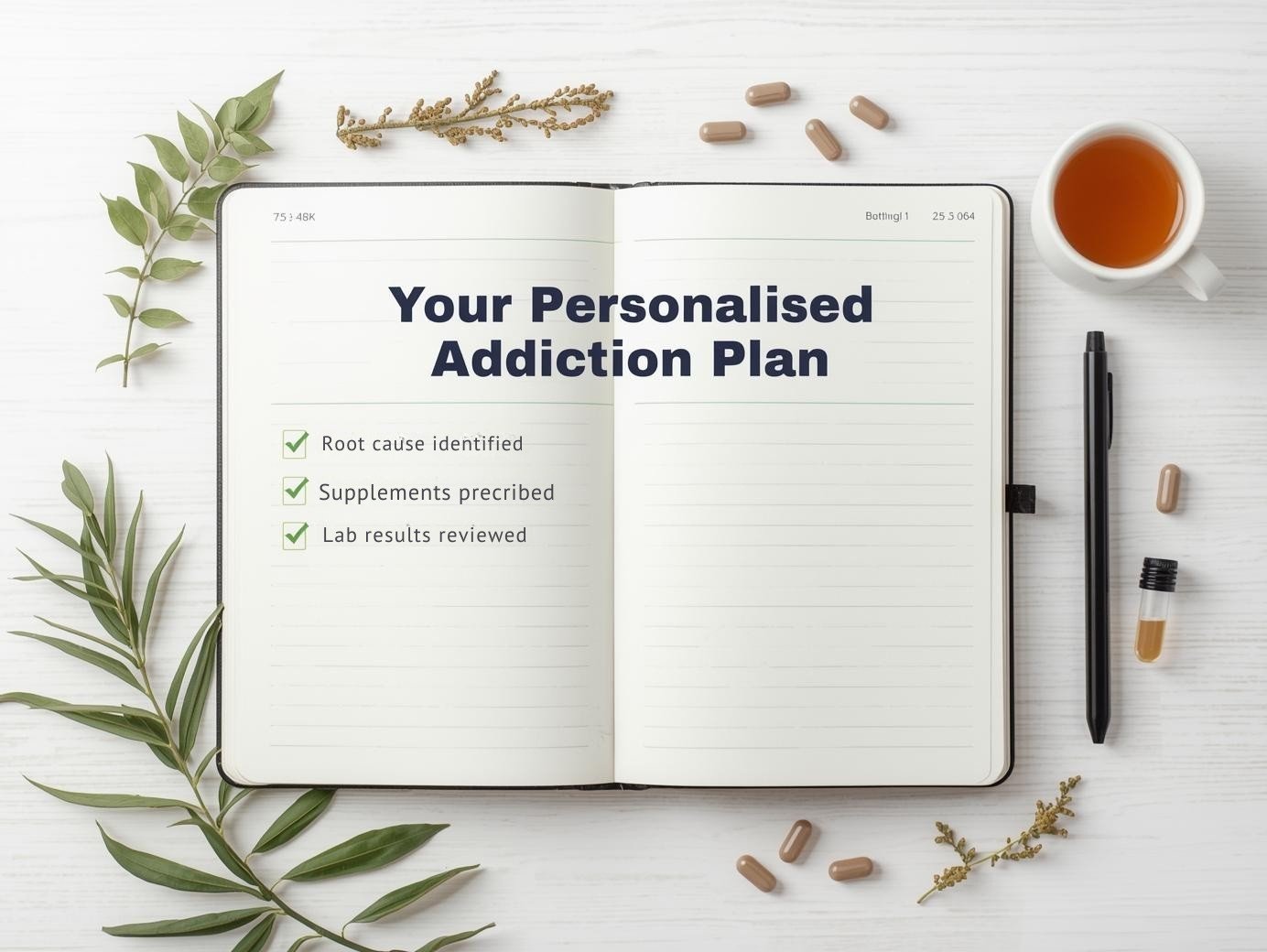
A personalised care plan grounded in functional and biochemical assessment
Targeted nutrition and supplement guidance, aligned with functional psychiatry and Walsh-informed principles where appropriate
Clear education, so you understand what’s happening in your brain and body — and why
Nervous-system and lifestyle support tailored to stability, rhythm, and resilience
A step-by-step roadmap, not a generic protocol or rigid program
Our focus is always on addressing root causes, not simply suppressing symptoms or chasing short-term fixes.
Suppressing a symptom and resolving what’s driving it are two very different outcomes — only one of them tends to last.
Ongoing Support (Not One-Off Care)
Addiction recovery — like nervous-system healing — is rarely linear.
Neither is our care.
As you move through each phase, we continue to:
Adjust nutrients and strategies as your system responds
Support nervous-system regulation and emotional stability
Help distinguish temporary setbacks from true relapse
Refine your plan using real-time feedback, not assumptions
This is the same commitment described at the very start of this page — that the brain adapts for survival, not wellbeing, and that recovery works best when the whole system, not just the symptom, feels genuinely supported along the way.
This is collaborative care, at your pace — focused on restoring trust in your body, not forcing change or pushing willpower.
There is a path forward — one step at a time.
With informed, compassionate support, stability can improve, cravings can soften, and clarity can return.
You don’t have to rush.
You don’t have to push.
And you don’t have to do this alone.